




Introduction
Fusaka entirely transforms Ethereum's data availability layer. For the first time, Ethereum moves from full replication, where every node stores every blob, to a sharded architecture where nodes store a variable subset of data columns depending on custody requirements. This is what makes the dramatic blob scalability improvements possible, gradually increasing max blob capacity from 9 to 72 by mid 2026, possibly even beyond.
But with this architectural shift comes a new challenge:
"how can users verify that the network is actually upholding its collective data availability guarantees?"
Today, together with the P2P Networking team at the EF, we're launching a live custody monitoring tool hosted inside The Lab to answer exactly that question, and several others, on a real-time basis.
The Sampling Problem
In the pre-Fusaka world, data availability was simple to reason about: if a node has a blob, its data is available. PeerDAS changes this logic fundamentally.
Now, each beacon node commits to storing a partial view of the data, which is erasure coded to add 2x redundancy, and then split into 128 columns, sized 2KiB each. Each beacon node calculates its column custody set from its identity and effective validator balance. Sufficient column diversity is required to reconstruct the blob matrix attached to a block, within its custody window of 4096 epochs (~18 days). This threshold is 64 distinct columns.
These new dynamics trigger the need to continuously measure network-wide reliability to answer crucial questions in real time:
- Are peers that claim to store certain columns indices actually storing them?
- Are peers successfully honouring their custody window?
- Are peers correctly serving data when requested?
- Are there any widespread compliance failures that could threaten data availability of certain blobs?
We can then close the loop by taking proactive actions when degradation is detected, such as alerting when custody for a particular blob matrix begins to approach a critical threshold, and initiating preemptive reconstruction and reseeding to improve availability ratios where needed.
Introducing Live Custody Monitoring
To provide visibility into these critical questions, we're launching a real-time monitoring dashboard that tracks custody compliance across the network. The dashboard is powered by dasmon, a custody monitoring engine developed by the P2P networking team at the Ethereum Foundation.
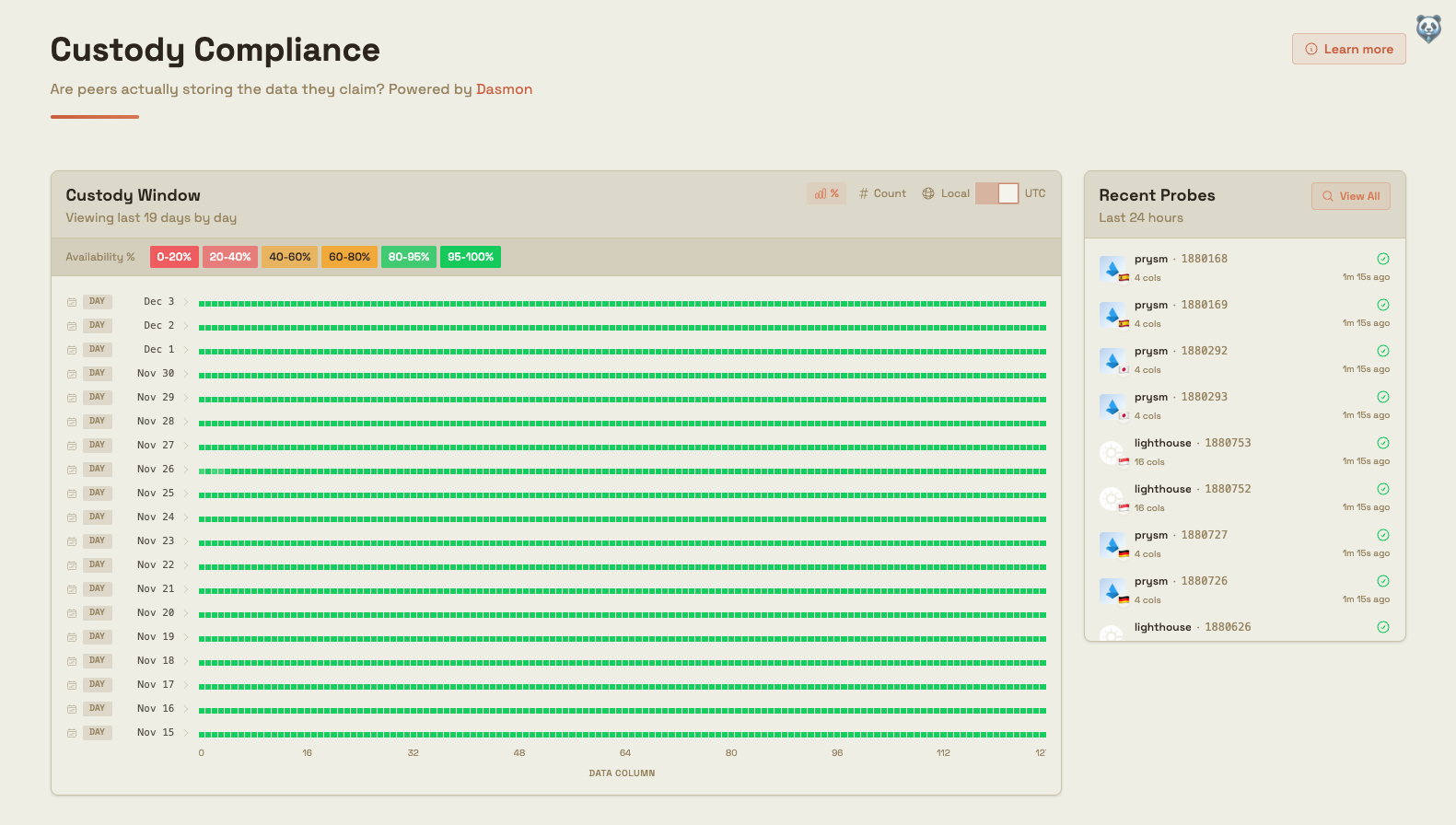
dasmon continuously samples peers across the network, testing their claimed custody ranges by requesting data columns and validating the responses against known KZG commitments. Every test result is logged, analyzed, streamed to Xatu, and surfaced in real-time on the dashboard. The evolution of custody windows is also tracked on a peer-by-peer basis.
What dasmon does
At its core, dasmon answers a simple question: are peers storing the data they say they're storing?
It does this through continuous verification:
- Peer tracking: dasmon automatically discovers and tracks peers joining the network, monitoring their custody metadata, which columns they claim to store, and for which slot ranges.
- Intelligent sampling: Rather than testing randomly, dasmon uses coverage-aware sampling to systematically verify untested (slot, column) combinations. This maximizes coverage while minimizing redundant testing.
- Response validation: Every response is validated against known KZG commitments. dasmon verifies not just that data was returned, but that the data matches what should be stored.
- Real-time event streaming: All test results, custody updates, and peer status changes are streamed in real-time to Xatu, enabling live monitoring dashboards and alerting like the one we’re sharing today.
- Historical analytics: the cumulative Xatu dataset enables long-term compliance analysis and trend detection.
Try it live
The monitoring dashboard is now live in The Lab. You can watch real-time custody compliance data flowing in as dasmon continuously verifies peers across the network.
This tool represents our commitment to making Ethereum's data availability layer not just scalable, but observable and verifiable. As the network transitions to PeerDAS, this visibility becomes essential for operators, researchers, and users who need confidence that the network's guarantees are being upheld.
Want to run a self-hosted dasmon?
dasmon is open source and can be integrated into any Ethereum consensus client. For operators interested in running their own monitoring infrastructure, reference implementations and documentation are available on Github.