








We had someone come up to us at Devconnect 2025 and ask us what exactly the team does, especially since we tend to be everywhere. That was a surprising moment, but it showed that we need to do a better job of communicating why the team works on what it does! The easiest explanation is: "Whatever Ethereum needs to ship forks securely and quickly". However, this is a vague statement. What does this actually entail? We'll try our best to explain ourselves while outlining what we aim to tackle in 2026!
It's been a huge year for the ethPandaOps team, We expanded our ability to ship forks, help host ACDT. revamped tooling, grew our data pipeline and set the stage for a productive year! The most obvious part of shipping a fork is co-ordination. A portion of the team is actively involved in herding EIPs through the process of acceptance on ACD, to prototypes, to interoperable client implementations and finally hardening the implementation to go live on Mainnet via testing. This pipeline of shipping EIPs requires extensive tooling to test and understand the feature before it goes live, hence a portion of the team works on tooling. The final portion of the team works on data, this is data that we feed into the first two portions - to understand EIPs, the effects of tests and to understand their implications for Mainnet. By tightly integrating these three portions, we're always able to have quick feedback loops for whatever changes core devs decide to throw our way.
Now that we've defined the three portions of the team, lets look a bit deeper into what's on our plate for the year:
Maintaining all of our tooling!
Across the fields of testing, network observability, data analytics, deployments and protocol development - we have a total of 30 tools. Not only do we maintain these tools, we also often contribute to their upstream dependencies to keep up with forks. These tools are critical for us to continue supporting Ethereum, they will always remain first priority for us. You can find an exhaustive list of tooling here.
Glamsterdam and Hegota
Glamsterdam is the next fork on Ethereum and is almost done finalizing scope. We are actively working on Block Level Access lists and ramping up our understanding of ePBS. We are currently updating our tooling to best visualize BALs and in the future will focus on tooling for test cases in ePBS. In order to do 2 forks a year, we need to start pipelining our efforts. We intend to start pushing for prototypes and figuring out testing as soon as possible to ensure we have a smooth pipeline with reasonable timelines. You can find some experiments using AI to speed up our debugging process in our ai-cookbook.
Tooling for Scaling
Over the last year, Ethereum has managed to scale the gas throughput by 2x as well as the DA layer by 3.5x. There are already plans for rapid scaling throughout the course of the year - both on the Gas and DA scaling fronts.
In order to help increase the gas limit, We collaborated with the Nethermind team, organized the scaling efforts, planned the rollout and analyzed the change on Mainnet. While the Nethermind gas benchmark tool has been invaluable this year, we notice some room for improvement as the scope for the tool grew. We plan on addressing this by improving the benchmark framework itself. The idea is to generalize the benchmark framework such that it integrates neatly with EEST while being used by the State research, Repricing initiative, Scale L1 and zkVM teams. This mostly involves making the tool easier to run locally, in a CI, on demand and with forks - all with minimal configuration. We additionally want to make this tool easier to contribute to, hopefully enabling L2 collaboration in scaling the EVM!
With the unbundling of DA increases from forks via BPOs, we intend to work with the p2p team to ship Partial cell proofs. This feature would allow for more scaling while allowing for a higher degree of reuse of blobs already in the mempool. This effort will be tied tightly to the data collection front, signaling when we are ready to scale.
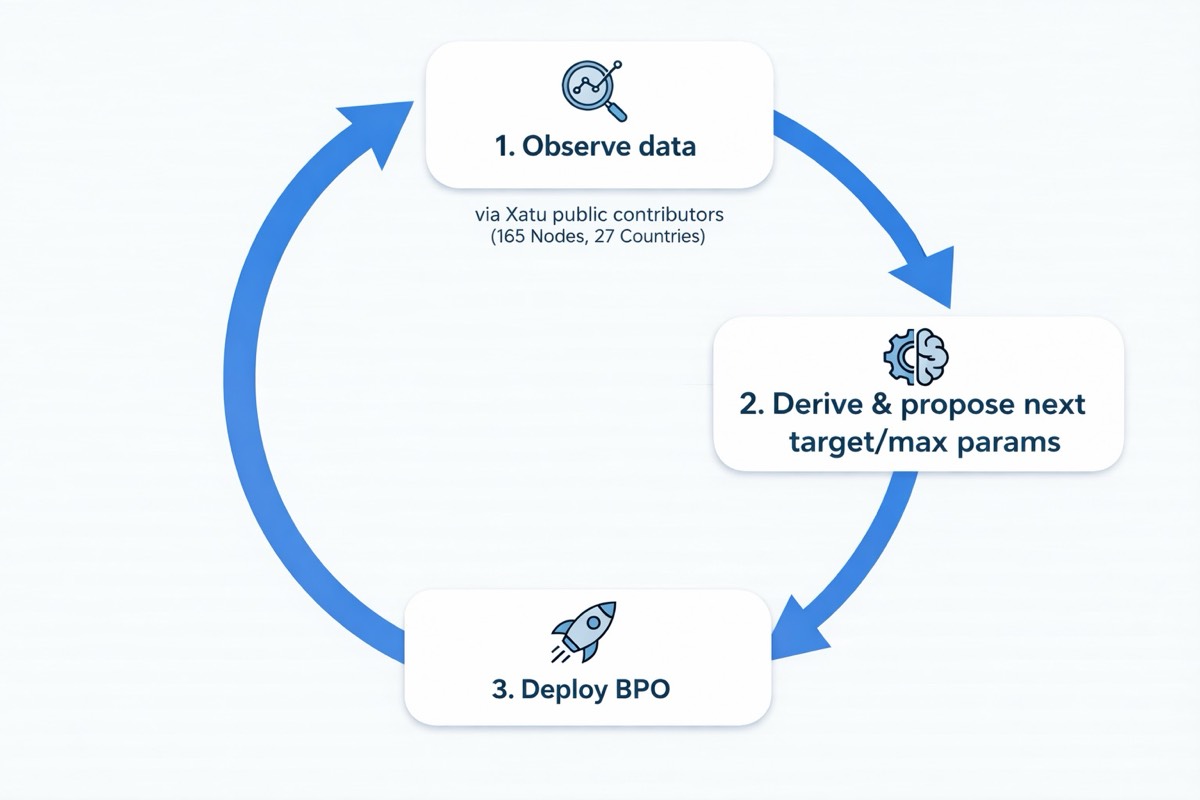
The BPO feedback loop: from Contributoor data to network analysis
Doubling down on Xatu
Xatu. What started as an internal tool in December 2022 has evolved into a full-fledged data pipeline that is now open source and available to the community. We open-sourced the dataset in March 2024 and since then we've been collecting and transforming data from multiple Ethereum networks. Xatu is going to continue to expand its scope over the year, acting as a central data lake for all of our endeavours.
Our data stack has historically been focused on the consensus layer. We intend to change this! We intend to look into the following topics this year, while also integrating them into the tracing and scaling efforts:
State Analysis: Understanding state growth patterns and access frequency, Informing state expiry discussions with real data
Engine API Timings: Measuring how long execution clients take to process blocks, Identifying bottlenecks and performance regressions
Transaction Analysis: Deeper mempool flow analysis, Transaction propagation timing across the network
Contract Analysis: OPCODE and precompile usage patterns,Gas consumption profiles across different contract types
Additionally we wish to start collecting data from L2s to help educate decisions on L1 better:
- Understanding how Layer 2s consume blobspace
- Tracking blob markets and pricing dynamics
- Monitoring the health of Ethereum's role as the data layer
The long-term vision includes extending Xatu's reach to capture Layer 2 network data directly, providing the same level of visibility we have for Layer 1 across the broader Ethereum ecosystem.
Expanding The Lab
We launched the lab in November to be the first stop for understanding Ethereum's protocol. This relaunch converted a side project into a full fledged member of our toolchain. This year, you can expect a lot more from the Lab: Execution layer views, State analysis, Data availability monitoring, and Live fork visualization. Additionally, If you can see it in the lab, you'll be able to query it in the Xatu dataset - enabling any reearcher to dig into theories. The data that comes out of the lab also helps us understand the effects of scaling Ethereum, allowing a strict feedback loop in our process.
The CBT pipeline (explained below) makes this possible. New models, new tables, new visualizations - the full stack from data transformation to API is automated. We'll be shipping curated views of the data, not just raw dumps.
Data Pipeline Evolution
CBT (ClickHouse Build Tool) lets us compose interconnected tables that build on each other. The xatu-cbt project currently contains 115 transformation models that power the lab, and we're working towards making them all available to the community in 2026.
These tables are faster to query than our raw event tables and more directly useful for common analysis patterns. Whether you're looking at attestation correctness, block propagation, or custody compliance - there's likely a pre-computed table that gets you there faster.
The pipeline is fully automated: code generation from ClickHouse schemas to Protobuf definitions to OpenAPI specs. When we add a new model, the entire stack updates.
Open Data Infrastructure
We believe in open data - all Xatu data is released under CC BY 4.0 - and we want to make it as accessible as possible. In 2026, we're expanding how you can access and work with Xatu data.
We're making more data available as Parquet files for local querying and research. This includes the CBT tables that power the lab - the derived views, not just raw events. We're also exploring Apache Iceberg data catalogs to make discovery easier - exposing a standard REST catalog interface so you can connect engines you already use, like Spark, Snowflake, and PyIceberg.
For those who want full data sovereignty we're working to make the entire pipeline - Xatu collection, CBT transformations, and API layer - easily deployable. You can run your own infrastructure, collect your own data, and maintain complete control.
ZKVMs
The world of ZKVM and Proving is approaching us quickly. We're working with the zkvm team to self host infrastructure to allow us to understand bottlenecks holistically. The testing stack for zkvms have been separate till now, we've started integrated the stack with our existing Kurtosis ethereum-package. This will allow us to test out optional proofs locally and enables rapid iteration, while fitting into the existing testing stack.
Hardening
Ethereum forks continue to increase the complexity of the Protocol. While we have some items in the roadmap intending to reduce the complexity, we need to still ensure that Ethereum today is hardened against attacks. We are working with the Lighthouse team at sigmaPrime to codify some attacks as well as fixes that don't require a fork to ensure a more resilient network. These are largely outcomes of the Holesky incident as well as Non-finality devnets over the last year. We will additionally plan more attack networks throughout the year, allowing us to help surface more areas to focus on. While devnets help find one layer of issues, we also aim to support the TxRx team in expanding the scope for Compliance testing to catch issues at the specification level.
Collaborations
We're building with teams across the EF and community:
EF Stateless Consensus Team Together we're exploring state access patterns and what they mean for Ethereum's stateless future. Some of the upcoming execution layer sections of the lab are built in collaboration with this team.
EF P2P Networking Team Our recent custody monitoring launch with dasmon is just the beginning. As PeerDAS goes live, this collaboration will be critical for ensuring the network's data availability guarantees are being met.
Scale L1 Working with the Scale L1 initiative on gas limit scaling, tracing, and benchmarking efforts to push network throughput.
STEEL Working with the STEEL team on all things testing related to the fork
zkEVM Working with the zkEVM team to ensure they get delivered safely
Client Teams Execution timing analysis, client diversity monitoring, and performance insights that help client teams optimize their implementations.
You? If you're working on research, testing, tooling, or analysis that could benefit Ethereum - we'd love to hear from you. Reach out via Twitter or the Xatu Telegram Group.
Thanks
We're extremely grateful for the continued support from the community that we've received via engagement and the Contributoor program. This team does what it does only because of you.
We're locking in for 2026. The Factory Must Grow.
Your ethPandaOps Team ❤️

The Factory Must Grow